Art Influenced by the Odyssey Art Influenced by the Odyssey
Past Emily R. Bass

What can we learn about life today from an epic almost monsters and gods, ancient conquests and a 20-year journeying past gunkhole? This was the question posed in The Odyssey Project: An One-time Story for Modern Times, on view at the Academy of New Hampshire Museum of Art through December 14.
The Odyssey Project is the first-ever group exhibition curated by a long-running artist-run volume order, who plant inspiration in Emily Wilson's contemporary translation of The Odyssey.
The 25-yr-old book club is made upwardly of 15 New England-based female artists, too as ane longtime member who passed abroad final year, Jenifer Gordon Mumford: Nancy Berlin, Ruth Fields, Carol Greenwood, Jane Kamine, Colleen Kiely, Marilyn Levin, Jennifer Moses, Karen Moss, Sterling Mulbry, Carla Munsat, Ellen Rich, Judy Riola, Civia Rosenberg, Sandra Stark and Brenda Star.
The group is connected by gender and profession, yet diverse in perspective and viewpoint. Since its founding, the social club has aspired to organize an exhibition or collaborative art project, and when Emily Wilson'due south translation of The Odyssey came out in 2017, the group knew straight abroad: This was the risk.

Wilson's is the first English language translation of the poem by a woman, a bespeak of view that graces each page of the book with accessibility and approachability. Whereas past translations were written past and for academics, Wilson rejects elevated, exclusive language. Her writing includes women, both in word choice and treatment of characters; Instead of calling the slave women Odysseus encounters "whores" or "creatures," a typical notice in past translations, Wilson merely calls them "girls," granting them the respect past translators take denied them.
Wilson'due south The Odyssey points a mirror inwards, self-consciously drawing attending to the underlying structures this classic tale is built upon: hierarchies of ability, gender and class that are as prevalent today equally they were in Homer'southward time. "The story is timeless, not timely," The Odyssey Project artist Carol Greenwood explains. The themes in the poem speak volumes to gimmicky dilemmas: migration and the (im)possibility of coming home, war and violence, the importance of family, and time's effect on relationships and personal identity. Like a roundtable discussion in a book club, this exhibition's forcefulness comes from the differing perspectives brought into conversation with one another. While each artist's piece of work shows highly personal reflections, the exhibition reveals threads of similar themes.
Although working in different media and styles, Carla Munsat (co-founder of Art New England) and Carol Greenwood examine Penelope and Odysseus's human relationship from similar viewpoints. Each is concerned with the lapse of time that passes during Odysseus's journey, reflecting on the effect that has on both individuals in the relationship—both the away and the awaiting.

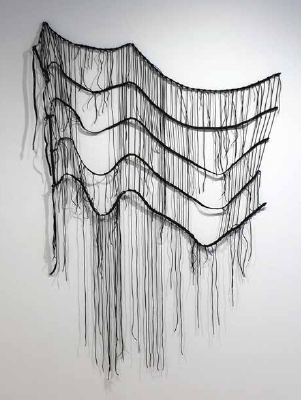
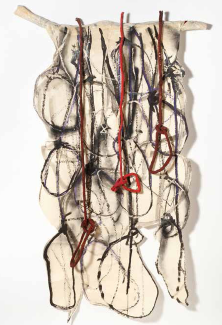
For xx years while her husband is at sea, Penelope wards off eager suitors past promising she'll choose a new married man every bit before long every bit she finishes weaving Odysseus's father a shroud. But at the end of each day, Penelope unravels all the weaving she'southward completed. Munsat's Penelope's Trick reflects the strain those 20 years had on her. Made from a repurposed leather coating used to protect a equus caballus from flies, the work evokes the concrete wearable and tear of Penelope'due south woven shroud, its thin strands curling and breaking off from handling over time. "[Penelope] experiences her attachment equally the destruction of her self," writes Wilson. Penelope cannot command her state of affairs, cannot bring her married man dorsum from war with pure will. She tin only exert control over a cloth for so long before information technology snaps and disintegrates.

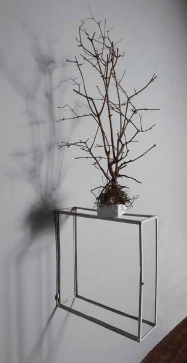
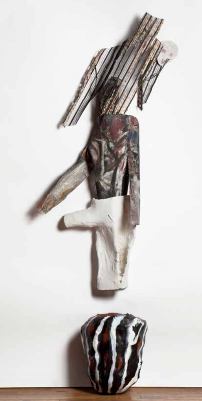
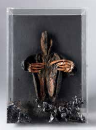
Greenwood similarly looks at the human relationship of Penelope and Odysseus in her visual poem, re:union. In The Odyssey, Penelope tests Odysseus to make sure the man before her is truly her husband by asking him to motion their bedframe. Odysseus reminds her that their bed is built around a big olive tree, rendering it immovable. Greenwood (who once took a drawing class based on The Odyssey during her studies at the School of the Museum of Fine Arts), revisited the symbol of the tree as the foundation for Penelope and Odysseus'due south marriage. Her plant object sculpture alludes to the "tenuous and sometimes surprising" elements of a long-term human relationship, blurring the lines betwixt securely rooted and finely balanced, kept together by circumstance yet easily toppled over with the slightest disturbance. The simple materials and visual composition of re:union let the viewer to see their own experiences and enquire: "What, if annihilation, remains unchanged over time?"

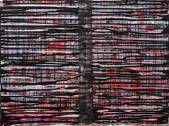
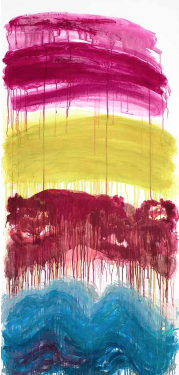
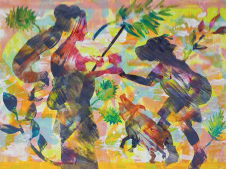
The trials and tribulations of Odysseus's journey prompted personal and political reflections from artists Jennifer Moses, Jane Kamine and Sterling Mulbry. Kamine began her painting Wine, Oil, Blood and Water with a personal reflection on the bodies of water she's lived along in her lifetime, at times living upon the Atlantic and Pacific, the Mississippi and the Hudson, and now, the Charles. In The Odyssey, "The Mediterranean becomes a protagonist often used past the Gods equally Odysseus'south adversary and eventual savior equally it carries him to state of war and eventually domicile," she says. What began with a meditation on water turned Kamine'due south focus towards the other liquids that bear the story along: claret as a symbol of both life and death; oil used to clean and heal wounded, weary bodies; vino as a marking of status and a symbol of hospitality offered to visitors. Each pigment Kamine lays on the canvas flows into the side by side, gravity pulling the paint downward. The movement in the piece implies a journey like Odysseus's—slow and total of unfolding meaning.

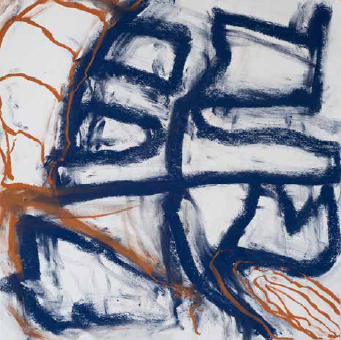
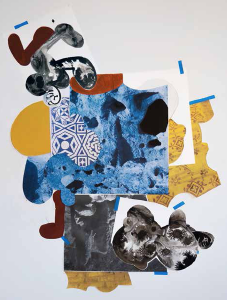
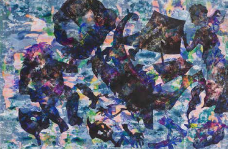
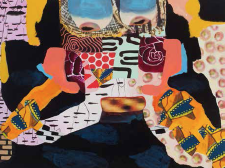
Moses's mixed-media wall collage Across The Body of water of Years captures the many layers of chaos and turbulence Odysseus faced in his journeying. An anthropomorphic contortion stumbles into the composition, its Matisse-like rounded trunk on the verge of being sucked into the body of water forever. Moses's collages consist of imagery personal to her: a yellowish design taken from a decorative fresco in Italy, which borders the collaged blue mass like a sandy shore simply out of reach; rough terrain photographed at Bandelier National Monument in New Mexico, rocky like the obstacles Odysseus faced; and pieces of other drawings and paintings from Moses's own work. Through these personal relics, Moses connects her journeys in life—as a painter and every bit a traveler—to the fabled trip of Odysseus.

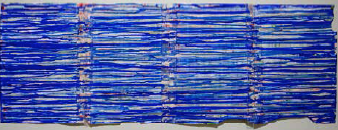
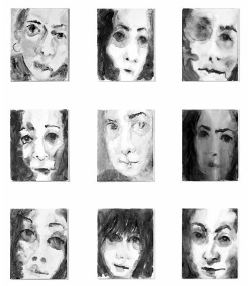
In her series of paintings on torn rag paper, Mulbry draws a parallel betwixt Odysseus'due south longing for home and recent conversations about migration. Throughout the poem, birds—"frequent migrants themselves"—are depicted as a stand up-in for the human being status. Mulbry'south intimate portraits of birds give a "face" to the event of clearing. "Daily, worldwide media streams stories of the migration of refugees fleeing for their lives, their search for their loved ones, and too often their deaths," she says. The torn rag paper the birds are painted on feels similar a relic, like a precious fresco removed from a wall for preservation, a pocket-size memorial to lives lost at sea or washed upwards on shore. By painting portrait homages to these migrants, Mulbry promises that these lives lost at bounding main will non be forgotten.

The Odyssey Projection: An Old Story for Modern Times celebrates similarity and difference. The exhibition is a conglomerate endeavour, a coming-together of different disciplines, backgrounds and perspectives. In improver to their artworks, the artists invited the UNH community to share their ain responses to Wilson'southward translation. The theater, music and trip the light fantastic toe departments created cross-subject area collaborations inspired by the book. Wilson's translation served as the source for the theater department'south ain production of The Odyssey. Over the past several weeks since the opening, many classes at the university accept also made their way through the galleries, connecting their writing to geography curriculums to the artworks on brandish.
"Political milieu today is that people pause down into piffling categories," says Greenwood. The artists in The Odyssey Project, operating in stark contrast to these divided communities, adopt to run across all the parts every bit a whole, "an all-encompassing social club."

Source: https://artnewengland.com/blogs/the-odyssey-project-an-old-story-for-modern-times-at-the-university-of-new-hampshire-museum-of-art/
0 Response to "Art Influenced by the Odyssey Art Influenced by the Odyssey"
Post a Comment